What Are the Top 3 Christian Prayers?
The top 3 Christian prayers have shaped believers for centuries. When people ask, “What are the three main prayers?” or “What are the most popular prayers?” the answer consistently centers on three foundational passages: the Lord’s Prayer, Psalm 23, and the prayer of surrender spoken by Jesus in Gethsemane.
These aren’t popular because they’re traditional. They’re popular because they work. They address fear, provision, forgiveness, weakness, and trust. Many believers also describe them as the 3 most powerful prayers in the Bible because of how deeply they shape faith and character.
You’ve likely heard them before. The real question is whether you understand them and actually use them.
Let’s go deeper.
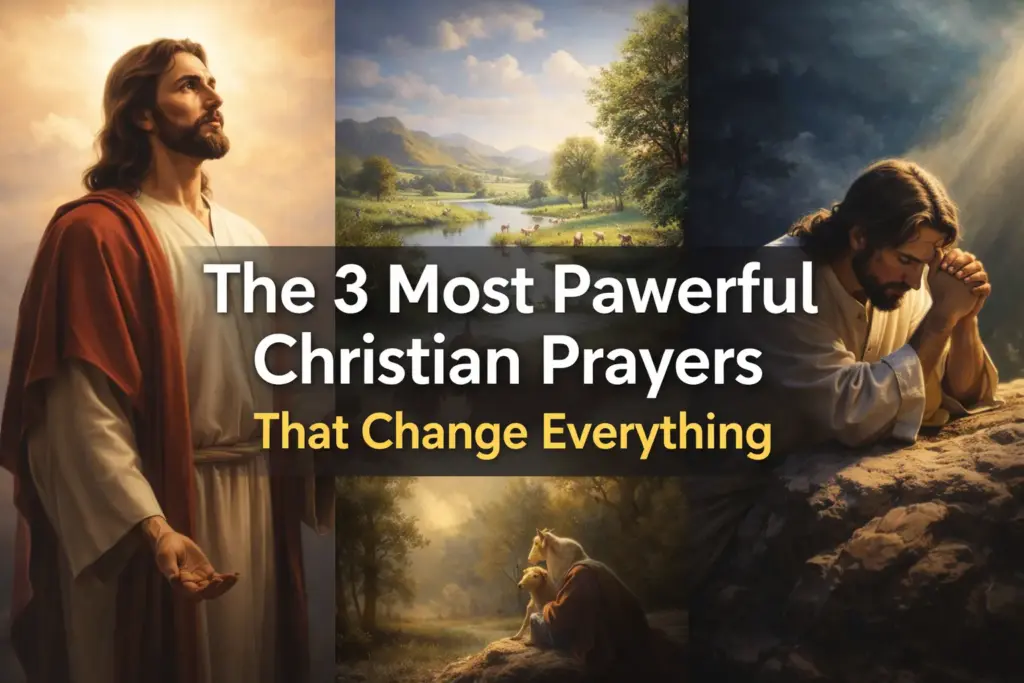
Table of Contents
Quick Overview of the Top 3 Christian Prayers
The top 3 Christian prayers most recognized across Protestant Christianity are:
The Lord’s Prayer
Psalm 23
Jesus’ prayer of surrender: “Not my will, but Yours be done.”
If someone searches for the top 3 prayers, they’re usually not looking for a long list. They want something solid. Something anchored in Scripture. Something reliable during pressure.
These prayers cover three essential spiritual needs:
• Relationship and dependence (Lord’s Prayer)
• Comfort in fear and suffering (Psalm 23)
• Surrender in crisis (Gethsemane prayer)
That range is not accidental. It reflects real life.
If you need a broader foundation first, this guide on what prayer really means helps clarify the purpose behind these practices.
Why These Prayers Stand Above Others
There are hundreds of written Christian prayers. So why are these consistently named the top 3 Christian prayers?
Because they are scriptural, structured, and psychologically grounding.
The Lord’s Prayer was taught directly by Jesus. Psalm 23 was written by David during hardship and continues to speak to suffering and fear. The prayer in Gethsemane reveals Christ wrestling with pain and choosing obedience anyway.
They aren’t polished church-only prayers. They were born in pressure.
Modern research on religious coping from institutions like Harvard Divinity School shows structured prayer improves emotional resilience. That isn’t surprising. These prayers create spiritual orientation when life feels chaotic.
They don’t remove hardship. They reframe it.
1. The Lord’s Prayer
The Lord’s Prayer appears in Matthew 6:9–13. Here is the full text:
“Our Father which art in heaven,
Hallowed be thy name.
Thy kingdom come.
Thy will be done in earth, as it is in heaven.
Give us this day our daily bread.
And forgive us our debts, as we forgive our debtors.
And lead us not into temptation, but deliver us from evil:
For thine is the kingdom, and the power, and the glory, for ever. Amen.”
This prayer begins with relationship before request. “Our Father” establishes identity. You’re not approaching a distant force. You’re approaching a Father.
Notice the order. Worship comes first. Then surrender. Then provision. Then forgiveness. Then protection.
That structure matters.
A common mistake is rushing through it mechanically. Instead, pause after each line. Ask yourself what it means personally.
“Give us this day our daily bread” challenges anxiety. It focuses on today, not five years from now.
“And forgive us… as we forgive” forces reflection. Many people pray for forgiveness while holding grudges. That contradiction weakens spiritual growth.
If you want to study the original biblical context, BibleGateway’s passage reference provides direct access to the Scripture.
This prayer teaches balance. Worship, surrender, dependence, accountability.
That’s why it remains at the center of the top 3 Christian prayers.
2. Psalm 23
Psalm 23 is one of the most recognized passages in Scripture. Here is the full text (KJV):
“The Lord is my shepherd; I shall not want.
He maketh me to lie down in green pastures: he leadeth me beside the still waters.
He restoreth my soul: he leadeth me in the paths of righteousness for his name’s sake.
Yea, though I walk through the valley of the shadow of death, I will fear no evil: for thou art with me; thy rod and thy staff they comfort me.
Thou preparest a table before me in the presence of mine enemies: thou anointest my head with oil; my cup runneth over.
Surely goodness and mercy shall follow me all the days of my life: and I will dwell in the house of the Lord for ever.
Amen.”
Why is this considered one of the 3 most powerful prayers in the Bible?
Because it acknowledges darkness without denying hope.
It doesn’t say valleys don’t exist. It says you won’t walk them alone.
The shepherd metaphor speaks of guidance and protection. Shepherds in biblical times defended sheep from predators and led them to water. That imagery would have been deeply comforting to ancient listeners.
Today, the same principle applies. When you feel directionless or overwhelmed, Psalm 23 reframes your perspective.
If you want deeper insight into its imagery, this explanation of Psalm 23 meaning explores the symbolism.
Use Psalm 23 when fear is loud. Speak it slowly. Replace abstract worry with specific trust.
That’s where its strength lives.
3. The Prayer of Surrender in Gethsemane
In Luke 22:42, Jesus prays:
“Father, if thou be willing, remove this cup from me: nevertheless not my will, but thine, be done.”
This is raw. Honest. Vulnerable.
He doesn’t pretend strength. He acknowledges pain. Then chooses surrender.
That balance is critical.
Many believers think prayer must sound confident at all times. Gethsemane shows otherwise. You can ask for relief and still choose obedience.
Real-life example: medical diagnosis. Financial collapse. Relationship breakdown. You pray for removal of the problem. But you also pray, “Your will be done.”
That surrender doesn’t mean passivity. It means trust in a larger perspective.
If you’re struggling in crisis, this page on prayer for strength offers practical words to guide you.
Surrender is not weakness. It’s alignment.
That’s why this remains one of the top 3 Christian prayers.
What the Top 3 Prayer Requests Reveal
When people ask for prayer, three themes dominate:
• Help in crisis
• Healing and protection
• Direction and clarity
These mirror the top 3 Christian prayers directly.
The Lord’s Prayer addresses provision and forgiveness. Psalm 23 addresses fear and safety. Gethsemane addresses suffering and surrender.
There’s alignment between Scripture and human need.
That’s not accidental.
How to Use These Prayers Daily
Morning: Pray the Lord’s Prayer slowly.
Midday stress: Repeat Psalm 23 lines.
Night: Reflect on surrender — “Not my will, but Yours.”
Consistency matters more than emotion.
Common mistake: only using these prayers in emergency moments. Depth grows through repetition in calm seasons.
Reading about the power of prayer reinforces why regular practice strengthens resilience.
Don’t rush. Don’t multitask while praying. Give it intentional focus.
Common Mistakes to Avoid
Reciting without reflection.
Skipping uncomfortable lines.
Using prayer as superstition.
Expecting instant results.
The top 3 Christian prayers are not shortcuts. They’re frameworks for transformation.
Transformation takes time.
Related Topics
FAQs
What are the three main prayers in Christianity?
The Lord’s Prayer, Psalm 23, and the prayer of surrender in Gethsemane.
What are the most popular prayers?
The Lord’s Prayer and Psalm 23 remain the most widely recognized globally.
Why are these considered the 3 most powerful prayers in the Bible?
They address provision, fear, forgiveness, and surrender — core human struggles.
Can I personalize these prayers?
Yes. Use them as frameworks and expand them with your own words.
Action Steps
Memorize one of these prayers this week.
Pray it slowly.
Reflect on one line daily.
Notice internal changes over time.
Depth builds quietly.