14 min read
Who Wrote Psalm 23?
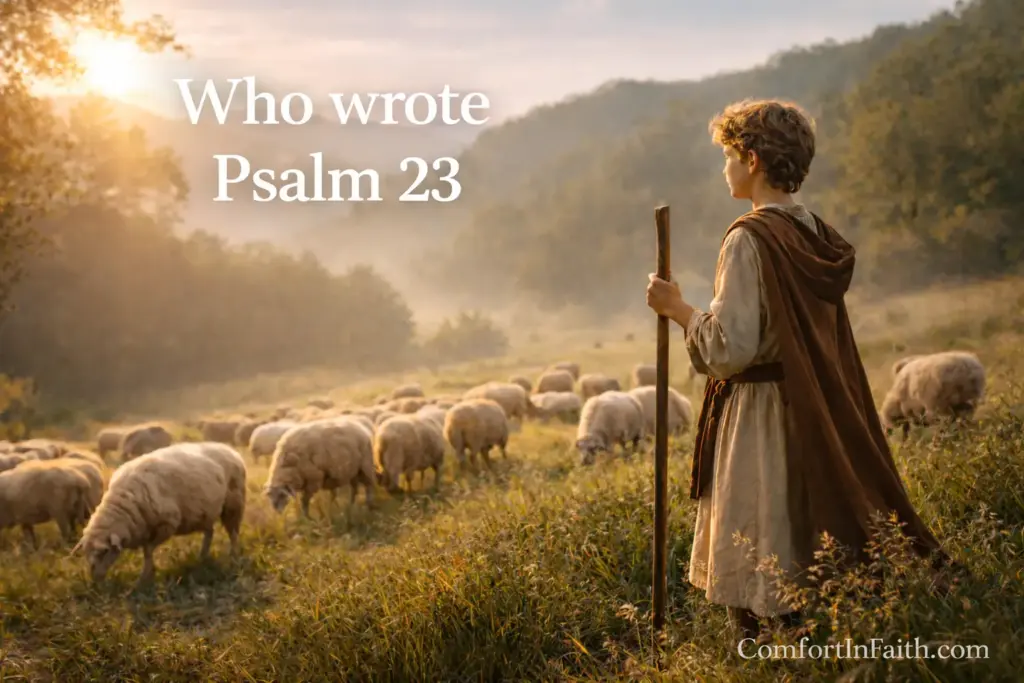
Psalm 23 is traditionally attributed to David. That’s the consensus across most Jewish and Christian reading. If someone asks “who wrote psalm 23,” you can answer “David” with confidence as the traditional attribution.
What you can’t do with the same confidence is claim a single, proven moment David wrote it, like “the exact day he fled Saul” or “the exact hour during Absalom’s rebellion.” The text doesn’t give a timestamp. That’s why good articles explain the strongest possibilities, and then show what the psalm is doing regardless of date.
If you want deeper meaning for the whole psalm (not just authorship), this page on Psalm 23 meaning helps anchor the themes you’ll reference throughout this article.
Why the Authorship Question Matters
Some people act like authorship is trivia. It isn’t. Knowing who wrote Psalm 23 changes how you hear it.
If David wrote it, then the “shepherd” language isn’t cute poetry from someone imagining farm life. It’s a man remembering what it’s like to keep vulnerable animals alive through real danger. That matters because Psalm 23 doesn’t read like fantasy comfort. It reads like tested comfort.
Here’s the tradeoff: obsessing over the “exact date” can distract from the psalm’s purpose. But ignoring background entirely makes the psalm feel generic. The winning approach is balance: give readers a strong answer, explain the plausible context, then show how it impacts interpretation.
Real-world scenario: someone searches “who wrote psalm 23” right after a funeral, during a breakup, or when anxiety spikes at 2 a.m. They’re not doing a history project. They’re reaching for stability. Background helps because it makes the comfort feel credible, not forced.
The Historical Setting Behind Psalm 23
Most Bibles include a short heading: “A Psalm of David.” That heading is a major reason David is traditionally named as the author.
One nuance that serious readers appreciate: in Hebrew, the phrase often translated “of David” can carry a range of meaning (commonly described as “by David,” “for David,” or “belonging to David”). That doesn’t erase David as author, but it explains why some scholars talk carefully. It’s not skepticism for the sake of skepticism. It’s language precision.
Still, the strongest internal evidence fits David well: the shepherd imagery, the personal voice, the confidence under pressure, the presence of enemies, and the mature tone that feels like hindsight. If you’re building topical authority, this is exactly where you show you’re both faith-centered and intellectually honest.
Authority reference you can cite for readers who want the passage itself: Psalm 23 on BibleGateway (KJV). Another widely used reference: Psalm 23 on Bible.com.
When Was Psalm 23 Written? The Most Likely Timeframe
“When was Psalm 23 written?” is one of the biggest supporting queries tied to “who wrote psalm 23.” Page-1 content often hints at an answer but rarely lays it out cleanly.
There are two common timing theories people mention:
First: David wrote it in youth while he was literally a shepherd. That fits the imagery, but it has a weakness. Psalm 23 talks about enemies and a life that has clearly known threat and conflict. That doesn’t automatically exclude youth, but it does sound like someone who has lived long enough to see patterns: danger, provision, restoration, betrayal, and perseverance.
Second: David wrote it later in life, possibly as king, reflecting on his youth as a shepherd. This is the “maturity reflection” view. It explains how the imagery can be vivid (he lived it), while the tone feels seasoned (he’s processed suffering).
There’s also a situational version of the second view: Psalm 23 may have been written during a crisis period (often associated with intense conflict in David’s life). You don’t have to lock yourself into one event, but you should say what’s plausible: Psalm 23 reads like it comes from someone who has walked through a valley and survived it.
If you want a dedicated timeline-style breakdown, your internal page on Psalm 23 background and history can support this section and keep users clicking deeper into your cluster.
How Old Was David When He Wrote Psalm 23?
“How old was David when he wrote psalm 23” is a classic query because people want something concrete. The honest answer is: we don’t have a confirmed age given in the text.
What you can do (and should do) is explain the range logically without inventing certainty.
If Psalm 23 was written while he was tending sheep, that suggests adolescence or early young adulthood. If it was written during kingship or later crisis periods, it implies adulthood or maturity.
The strongest reading is not “David was exactly X years old.” The strongest reading is: the psalm reads like mature faith. It’s not naive optimism. It’s calm confidence that can only come from being tested.
That’s also where your content can stand out. You’re not guessing numbers. You’re interpreting signals in the text: enemies, valleys, a prepared table “in the presence of my enemies,” and a long-range outlook.
What Caused David to Write Psalm 23?
“What caused David to write Psalm 23?” is where your article can outperform devotional-only competitors. People want the trigger, the felt need, the reason.
Psalm 23 doesn’t sound like a poem written on a perfect day. It sounds like a declaration written to stabilize a soul.
David’s life included sharp transitions: seasons of quiet and seasons of threat. The psalm carries both. It moves from green pastures to shadow valleys. That range is the point. David is saying, in plain terms, “God’s care doesn’t stop when life gets ugly.”
A practical insight that helps readers: Psalm 23 isn’t promising a valley-free life. It’s promising presence in the valley. That’s why it works for grief, anxiety, and stress. It doesn’t insult people with unrealistic positivity.
If you want to connect this emotionally for readers who are suffering right now, linking to your Prayer inspired by Psalm 23 gives them a next step that feels personal, not academic.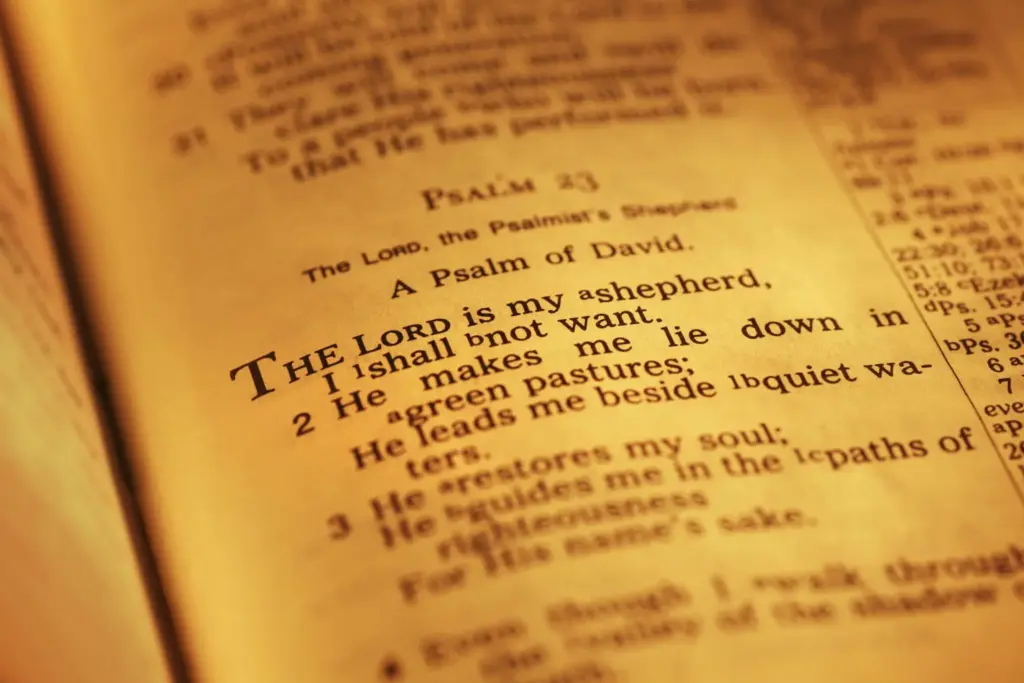
Psalm 23 Background Story
Psalm 23 background story matters because the shepherd metaphor is doing heavy lifting.
In David’s world, shepherding wasn’t romantic. It was gritty. Sheep wander. Sheep panic. Sheep get stuck. Sheep are vulnerable. A shepherd didn’t just “lead.” He guarded, corrected, searched, and stayed close.
That makes the famous opening line land differently: “The Lord is my shepherd.” It’s not a Hallmark phrase. It’s a claim of active care.
This is also why Psalm 23 is often “explained beautifully” when writers show the shepherd’s job: guiding to water, keeping sheep from danger, protecting from predators, and making hard calls when needed. The image is tender, but it’s not soft.
If you’re building topical authority, reinforce this with internal linking to your symbolism content: Psalm 23 symbolism explained.
Who Is Speaking in Psalm 23?
“Who is speaking in Psalm 23?” The speaker is the psalmist, traditionally David, speaking in the first person.
One detail readers miss (and it’s worth highlighting): there’s a shift in the psalm’s grammar. Early lines talk about God as “He.” Then, in the valley section, the psalm turns to “You are with me.” That shift is powerful.
It’s not just poetry. It signals intimacy. In peaceful moments, it’s easy to talk about God. In the valley, people talk to God.
Real-world scenario: when you’re calm, faith feels philosophical. When you’re scared, faith becomes relational. Psalm 23 captures that transition in a way that feels honest.
This is also a good place to add an internal link that supports verse-specific intent: Psalm 23:4 meaning.
What Are the Three Main Points of Psalm 23?
“What are the three main points of Psalm 23?” This question shows up constantly because people want a clean structure.
Here’s a strong three-point framing that matches the text:
First: Provision
God provides what’s needed: rest, guidance, nourishment, restoration. This is the “green pastures” and “still waters” part. It’s not luxury. It’s sufficiency.
Second: Presence
The central comfort is not perfect circumstances. It’s “You are with me.” This is why the psalm holds up under grief. Presence is the antidote to isolation.
Third: Protection
The rod and staff, the prepared table in the presence of enemies, the anointing, the overflowing cup. Psalm 23 doesn’t pretend enemies don’t exist. It claims God’s care is bigger.
A practical insight: when people read Psalm 23 only as “comfort,” they sometimes miss the strength in it. David isn’t soothing himself with vague hope. He’s stating realities: guidance, presence, protection.
Psalm 23 Original Language
“Psalm 23 original language” searches usually come from readers who want meaning beyond English phrasing.
You don’t need to turn your post into a seminary lecture. But a few careful insights help.
First, “The Lord” in many translations is presented as a covenant name for God (often rendered in uppercase in English Bibles). That signals relationship, not distance. David is not praying to an unknown deity. He’s speaking to the God he trusts.
Second, the famous “valley of the shadow of death” phrase is often discussed as a poetic way of describing extreme darkness, danger, or threat. Even without a technical deep dive, your point should be clear: the image includes fear, but it isn’t fear’s victory.
Third, Psalm 23 has rhythm and structure that makes it easy to memorize. That’s one reason it spreads. This matters for SEO because it answers “why is psalm 23 famous” with something practical, not mystical.
If your readers want old-language style, you can address “Psalm 23 old English” by acknowledging that KJV-style phrasing is common and beloved, but modern translations can help people grasp meaning faster depending on their background.
Rod and Staff Meaning in Psalm 23
Your keyword cluster around rod and staff is strong, and it’s one of your best internal-link assets.
Rod and staff meaning in Psalm 23 is simple at the core: guidance and protection.
The “rod” is often associated with defense and correction. The “staff” is commonly seen as support, direction, and keeping the sheep close. Whether someone interprets them as two tools or one tool described two ways, the outcome is the same: the shepherd is equipped.
Here’s the practical, human takeaway: comfort doesn’t always mean soft. Sometimes comfort is knowing someone has the strength to protect you and the wisdom to correct you.
Common mistake: people read “rod” and think punishment only. That narrows the meaning. In the psalm’s context, the rod and staff are comforting because they represent competence. The shepherd isn’t helpless.
For deeper topical authority and internal flow, link to your supporting page: Rod and staff meaning in Psalm 23.
Why Is Psalm 23 Famous?
“Why is Psalm 23 famous?” Easy: it’s memorable, deeply human, and it fits real moments.
Psalm 23 shows up at funerals because it names death’s shadow without collapsing into despair. It’s used in hospitals because it frames suffering without denying it. It’s quoted in anxiety because it focuses on presence.
Another reason it’s famous: it’s short enough to memorize and rich enough to keep returning to. That’s rare.
A useful observation: the psalm doesn’t shame people for fear. It answers fear with presence and guidance. That’s why it doesn’t age.
Common Mistakes People Make Reading Psalm 23
First mistake: using Psalm 23 only for death or funerals. That’s one use, not the only use. The psalm is built for everyday fear, everyday decisions, everyday fatigue.
Second mistake: reading it like a promise of a problem-free life. It explicitly includes enemies and valleys. The promise is not avoidance. The promise is companionship and provision.
Third mistake: skipping the personal angle. “My shepherd” matters. This is not just a poetic statement about God in general. It’s a relationship claim.
Fourth mistake: turning it into superstition. Psalm 23 isn’t a charm. It’s a confession of trust. The power is not in the words as magic. The power is in the faith they express.
Related Topics
Suggested image placement: a simple infographic-style “3 main points of Psalm 23” graphic near this section.
Alt text idea: “Three main points of Psalm 23: provision, presence, protection.”
FAQs
Did David definitely write Psalm 23?
Psalm 23 is traditionally attributed to David, and that attribution is widely accepted in Jewish and Christian tradition. Some discussion exists about how ancient headings function, but David remains the strongest and most natural fit.
Who is speaking in Psalm 23?
The speaker is the psalmist, traditionally David, speaking in first person about his relationship with God as shepherd.
When was Psalm 23 written?
The text doesn’t give a date. Many readers believe it reflects David’s mature faith, possibly written later in life while remembering his shepherd years, especially because the psalm references enemies and danger.
What caused David to write Psalm 23?
It reads like a trust declaration shaped by real pressure. David’s life included threat, betrayal, and hardship, and the psalm frames God’s care through those seasons.
What are the three main points of Psalm 23?
Provision, presence, and protection. God supplies needs, stays near in the valley, and defends and guides like a capable shepherd.
Which psalm did Adam write?
The Bible does not identify Adam as the author of any psalm. The psalm are attributed to several figures (including David), but Adam is not listed among them.
Action Steps
Read Psalm 23 slowly once a day for a week. Don’t rush it.
Write one sentence naming your current “valley.” Be honest.
Repeat the turning-point line in prayer: “You are with me.”
Memorize Psalm 23:1 or Psalm 23:4 and use it when anxiety hits.
If you want a practical next step, pray through your situation using a prayer inspired by Psalm 23.
Go deeper in the Psalms with a trusted devotional or study guide.